
2023-2024 VanCraft User Manual PDF
NOTE: This User Guide is general in coverage of the vehicle components and systems. Some
of the exact equipment or functions may have been changed due to continuous product
improvement. Your vehicle might differ slightly from the information included herein.
Descriptions, images, and specifications were correct at the time of printing, but VanCraft
LLC reserves the right to make changes, without notice, and without obligation to install the
same products previously manufactured. In addition to this User Guide, your Camprervan
came with the manufacturer’s user manuals for various appliances and systems in your
Campervan. Many of these systems are covered in this User Guide, but some information
may only be found in the manufacturer’s manuals. Please keep these documents handy
should you have questions
Your VanCraft Campervan was built on a Mercedes-Benz® Sprinter chassis. You will find
references throughout this User Guide to the Sprinter chassis and Sprinter operating
instructions provided with the vehicle. Please refer to the Sprinter operating instructions for
information regarding the operation, safety, and maintenance of the original vehicle chassis.
SAFETY MESSAGES USED IN THIS USER GUIDE
This User Guide alerts you to common safety or vehicle hazards using the following labels:
WARNING Indicates a hazard that may endanger your health or life, or the health or life of others.
Pre-Delivery Inspection: VanCraft Campervans takes pride in providing a high quality
campervan product. Our team inspects every Campervan closely before delivery. Our team is
responsible for completing a comprehensive pre-delivery inspection and correcting any
issues with the chassis or Campervan components prior to delivery. Before driving, familiarize
yourself with all local and state laws as different areas may have laws that apply to your
Campervan.
GENERAL WARNINGS
● All seats should be locked in the travel position while the vehicle is moving.
Passengers should only use seats with seatbelts while the vehicle is moving.
● Child restraints should be installed properly according to the manufacturer’s
instructions.
● Never let passengers stand or kneel on seats while the vehicle is moving.
● All tables should be stowed when the vehicle is moving.
● Verify doors and drawers are shut and latched, where applicable, when the vehicle is
moving.
● Passengers should never use the beds while the vehicle is moving.
● Inspect the fire extinguisher monthly and before each trip for proper charge and
operating condition.
● Adverse weather conditions and extremes in terrain may affect the handling and/or
performance of your vehicle. Refer to your Sprinter Manual for more information.
WARNING
Operating, servicing and maintaining this vehicle can expose you to chemicals including
engine exhaust, carbon monoxide, phthalates, and lead, which are known to the State of
California to cause cancer and birth defects or other reproductive harm. To minimize
exposure, avoid breathing exhaust, do not idle the engine except as necessary, service
your vehicle in a well-ventilated area and wear gloves or wash your hands frequently when
servicing your vehicle. For more information go to
www.P65Warnings.ca.gov/passenger-vehicle.
Pregnant Women never place a shoulder belt behind your back or under your arm. Adjust the
lap belt across your hips/pelvis and below your belly. Place the shoulder belt across your
chest (between your breasts) and away from your neck.
WARNING
This motorhome has been designed, manufactured and tested with concern for the
protection of its occupants. We recommend you perform the following inspections for your
safety and the safety of your passengers before starting your vehicle.
WHEELS – Inspect for damage and check lug nuts for tightness.
TIRES – Inspect for wear and damage and check for recommended air pressure.
LIGHTING – Test for proper operation of all interior and exterior lights including dash lights,
headlights, and turn signals.
EXITS –Test both locks on the main entrance door for ease of operation and instruct
passengers how to use both means of exit.
SEAT BELTS – Direct passengers to designated seats, be certain swivel seats are locked
into position, and require use of a seat belt. See operator’s manual for occupancy and
weight restrictions.
APPLIANCES – Turn off and latch or lock doors where provided.
LOOSE PARCELS – Store securely.
CARBON MONOXIDE WARNING
WARNING
Avoid inhaling exhaust gasses, as they contain carbon monoxide, which is a colorless,
odorless, and poisonous gas. Death or serious injury can result.
Combustion engines emit carbon monoxide (CO), which can be harmful or potentially deadly.
Keep CO out of the cabin by maintaining the vehicle exhaust and the ventilation systems.
Have the exhaust system inspected from time to time by a qualified RV service center:
● When the vehicle is serviced
● If the sound of the vehicle exhaust system changes
● When damage occurs to the exhaust, underbody, or rear of the vehicle
To allow for proper operation of the vehicle’s ventilation system, keep the front grill clear of
snow, leaves, or other obstructions.
WARNING
Do not occupy a parked vehicle with the engine running for an extended period. Do not run
the engine in confined areas, such as a garage, except to move the vehicle in or out of the
area.
SMOKE AND CARBON MONOXIDE ALARM
Your campervan is equipped with an alarm that will sound if it detects smoke or carbon
monoxide in your vehicle. This system should be tested after the vehicle has been in storage,
before each trip, and at least once per week during use by pressing the Test/Reset button.
WARNING
Test combination smoke / carbon monoxide alarm operation after the vehicle has been in
storage, before each trip, and at least once per week during use. Failure to do so can result
in death or serious injury.
California Proposition 65 Warning: Battery posts, terminals, and related accessories
contain lead and lead compounds, chemicals known to the state of California to cause
cancer and reproductive harm. Wash hands after handling.
PINCH HAZARDS
Any time items open and close, like a door or cabinet, or move, like a rotating or folding seat,
there is a potential pinch point. Avoid any moving areas of a mechanism to prevent injury.
FORMALDEHYDE INFORMATION Like in every home and building, some materials in this Campervan may emit formaldehyde.
Eye, nose, and throat irritation, headache, nausea, and asthma-like symptoms, including
shortness of breath have been reported as a result of formaldehyde exposure. Reaction to
formaldehyde exposure may vary among individuals and research is continuing on the
possible long-term effects of exposure to formaldehyde. Inadequate ventilation may allow
formaldehyde and other contaminants to accumulate in indoor air. Ventilate your RV before
and during each use using the windows, exhaust fan or air conditioning system. If you have
any questions regarding formaldehyde, consult your doctor.
MOLD
Mold is a natural part of our environment. It plays an important role in helping break down
dead leaves and organic matter into fertile soil. The very nature of your RV being outside will
bring it into contact with mold, but indoor mold growth should be avoided.
To reduce mold growth, reduce the things in your RV that could allow mold to grow. Mold only
needs small amounts of moisture and nutrients from food spills or grease, or it could survive
on as little as a fine layer of dirt or dust. Keep the inside of the vehicle as clean and dry as possible. Moisture plays a large part in mold
growth. Don’t allow condensation to build up inside the vehicle and keep the interior humidity
levels low. Proper ventilation helps and using the air conditioner and or the auxil can remove
excess moisture from the air.
Avoid and repair leaks immediately as they are a major contributing factor to mold growth. If
mold develops, clean the area with soapy water followed by a bleach solution. If the items
cannot be treated, they should be removed and replaced.
MOLD AND WARRANTY CLAIMS
If VanCraft determines that mold in your campervan was caused by a manufacturing defect
reported to VanCraft within the warranty period, VanCraft will clean the affected area(s) and
/or replace items it deems necessary. This is the only circumstance in which VanCraft will
cover mold under its limited warranty.
VanCraft, LLC will not assume responsibility for mold deemed to be a result of a user’s lack of
timely and appropriate action to mitigate circumstances should a problem occur.
CONDENSATION
When it is humid in the van, condensation can develop inside the windows which can lead to
damage if not properly addressed. It is best to keep moisture low with proper ventilation, but
under certain circumstances ice can form if excessive condensation gets trapped between a
window shade and the glass. If the ice or excessive sweating is not addressed and dried
properly, it can melt and drip into the dashboard, electronics, upholstery or other areas that
water may damage. Do not allow water to enter sensitive areas by carefully removing ice and
drying the moisture to prevent damage.
TIP: When using window shades, position the shades as close to the glass as possible to
prevent moisture build up. VanCraft, LLC does not assume responsibility for damage caused
by water dripping into the dashboard, upholstery or other areas related to condensation or
ice melting into those areas.
ELECTRICAL CAUTIONS
WARNING
Careless handling of electrical components can be fatal. Never touch or use electrical
components or appliances while feet are bare, while hands are wet, while standing in water,
or on wet ground.
Avoid overloading electrical circuits and only replace fuses or circuit breakers with those of
the same size and amperage rating. Never use a higher rated fuse or breaker. Use caution
when handling or working near energy storage systems and electrical components. Always
remove any jewelry and wear protective clothing and eye covering and avoid creating sparks.
GENERAL VEHICLE INFORMATION
LOADING THE RV
Before driving, always secure loose items which can become dangerous projectiles in sudden
stops, quick maneuvers, and accidents. Distribute weight evenly to help vehicle handling.
Never exceed the GVWR (Gross Vehicle Weight Rating) or the GAWR (Gross Axle Weight
Rating). GVWR is the total allowable weight of the vehicle, including passengers, cargo
(including water), and possible tongue weight of a towed trailer.
The GAWR is the weight the axle is rated for. The combined measured weight at the front
wheels plus the measured rear wheel weight should never exceed GVWR. Additionally, never
exceed the individual tire weight ratings. Never exceed the GCWR (Gross Combination
Weight Rating), the maximum total weight of the vehicle and anything towed.
WEIGHING THE RV
Weigh your fully loaded van to determine the proper load distribution of cargo in your vehicle.
Weigh fully loaded, including fuel, fresh water, food, bedding, passengers, gear and other
items you will carry.
FINDING A SCALE
Commercial truck stops usually have scales, but there are other commercial scales around
that may charge a small fee.
WEIGHING PROCEDURE
Measure the front axle weight, rear axle weight, total vehicle weight. To get a front axle
weight, drive only the front wheels onto the scale. To get a total vehicle weight, drive all
wheels onto the scale. To get a rear axle weight, drive the rear wheels only onto the scale.
Compare these measurements to the GVWR, and the GAWR for the front and rear axles,
found on the Vehicle Certification label inside the driver door area.
TOWING WITH YOUR VAN
The Sprinter is rated to tow a maximum load of 5,000 lbs. Towing capacity may be less than
the hitch rating based on the weight of your loaded vehicle. When towing, do not exceed the
GVWR, the rear axle GAWR, or the chassis GCWR by the combined loaded weight of the
VanCraft Campervan and the towed item. Towing will affect vehicle handling, durability, and
fuel economy. Exceeding any of the listed Gross Weight Ratings will result in unacceptable
overall vehicle performance and, potentially, danger.
HITCH ASSEMBLY
If a towing brake system is required, we recommend use of a modulated braking device
versus a surge-style system. The actual tongue weight should never exceed the stated hitch
vertical load. This is typically defined as the tongue weight of a towed vehicle hitch, boat
trailer tongue weight, or a receiver-mounted carrier rack.
ROADSIDE EMERGENCY
Due to the weight and size of the vehicle, we recommend you seek professional road service
to help in the event of a roadside emergency such as a flat tire. If the situation requires you to
change a flat tire yourself, be very careful and read all the information in your Sprinter
Operating Instructions regarding the changing of a tire. Check your tires for proper inflation
before each trip, and at least once a month, using an accurate tire gauge.
IF YOU GET A FLAT TIRE
Do not panic. Grip the steering wheel firmly and steer the vehicle as straight as possible. You
may need to counter-steer to compensate for pull created by the failed tire. Do not
stomp/slam on the brakes. Do not jerk your foot off the accelerator. Just ease back on the
accelerator slowly and gently to continue the momentum. The deflated tire will slow the
vehicle. If you must change lanes to get to a safe stopping place, use your signals to warn
other motorists and change lanes smoothly after you are certain the lane is clear. Let the
vehicle coast to a stop, gently steering to a safe stopping place, then activate the hazard
flashers and exit the vehicle carefully. Set out flares or other warning devices.
RECOVERY TOWING
Due to modifications of the RV from its original chassis specifications, notify the towing
service of the height and weight of the RV (Height is 9’+) as it may change how they recover
the vehicle. This information is found on the Vehicle Certification Label. Refer to the Sprinter
Operating Instructions on towing the Sprinter. VanCraft, LLC does not assume responsibility
for damage incurred while towing this vehicle.
ENGINE OVERHEATING
If you see or hear steam escaping from the engine compartment or have reason to suspect
an engine overheating condition, pull the vehicle over, stop the engine, get passengers out of
the vehicle and consult the Sprinter Operating Instructions.
JUMP STARTING
If you wish to try jump-starting the engine, see the Sprinter Operating Instructions.
DRIVING YOUR CAMPERVAN
See your Sprinter Operating Instructions for information on items like driving controls,
instrumentation, cruise control, climate controls, gauges, wipers, lights, safety belts, and
other chassis related features.
FRONT SEATS
The front seats of your van are adjustable in various ways, the passenger seat also swivels to
face the rear of the vehicle. See your Sprinter Operating Instructions for more information on
front seat adjustments.
NOTE: Damage to interior door panels may result if seats are swiveled toward the doors. Do
not turn the passenger seat clockwise, adjust the seat all the way toward the front of the van
before spinning.
NOTE: When the vehicle is in motion, the driver and passenger seat must be locked in the
forward position.
SEAT BELTS
All seating positions have seat belts which should be used anytime the vehicle is in motion.
WARNING
Never sit anywhere in the van that does not have a seatbelt while the vehicle is in motion.
NOTE: After any serious accident, all seat belts in use during the accident must be inspected
and replaced if necessary
CHILD RESTRAINTS
When properly used, child restraint systems reduce the risk of injury in an accident or sudden
maneuver. If installed or used incorrectly, child restraints can increase the risk of injury. Refer
to your child restraint system’s instructions for installation instructions.
NOTE: Rear bench seating can be used with a child restraint system designed for use with
lap-only style seat belts.
NOTE: The rear bench seating does not have a ratcheting style belt retractor.
FACTORY DASH CLIMATE CONTROLS
The Sprinter dash climate controls were designed to heat and cool the front cabin area only,
not the entire cabin. See Sprinter Operating Instructions for details and instructions covering
dash A/C, heat, and defrost functions. See the Cabin Climate Control System section of this
User Guide for details regarding the VanCraft Campervan heating and cooling systems.
Infotainment Systems and Driver Assist Features Consult the Sprinter Operating Instructions
for information and operation instructions regarding your Sprinter infotainment, radio,
navigation, Bluetooth, cameras, external sensors and the like.
VEHICLE MAINTENANCE
The VanCraft Short and Long Wheelbase vans are built on a Sprinter chassis and require
routine maintenance and service outlined in the Sprinter Operating Instructions
FRONT AXLE ALIGNMENT AND TIRE BALANCING
Once the campervan is fully loaded, get the alignment checked and adjusted, if necessary.
After that, the alignment should be periodically inspected to help prevent uneven tire wear.
Excessive or abnormal tire wear may indicate worn or misaligned suspension, an unbalanced
tire, or other problems. Alignment can also be affected by incidents such as hitting a curb,
pothole, or railroad track.
NOTE: Have your dealer, or RV service technician, inspect your vehicle’s suspension and
steering components periodically for misalignment or wear. Refer to the Sprinter Operating
Instructions provided with your vehicle for further information.
TIRES
This vehicle came with tires different from the original Sprinter and has a modified tire label in
the driver door area with information regarding proper tire pressures.
NOTE: Improper tire pressure can cause abnormal or premature wear, affect vehicle handling,
and fuel economy. The wheel lug bolts needed to be checked and torqued periodically and
any time the wheels were removed and reinstalled.
SPARE TIRE
Refer to the Sprinter factory manual for information on accessing the spare tire.
CONTROL PANELS AND FUNCTIONS
The VanCraft Long and Short Wheelbase campervans have various cabin controls. The main
Renogy power system can be controlled either at the solar controller in the utility bay or via
the Renogy BT app for Apple iOS and Android. Inverter and pump switches can be found in the
main cabin, as well as controls for camper heat and A/C. Refer to each system's specific
instructions section further in the manual for more information.
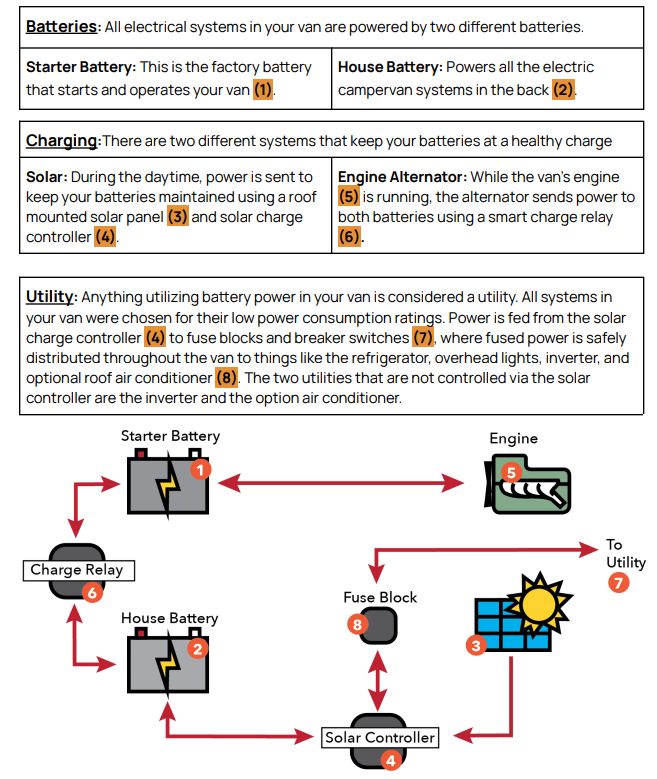
OFF GRID 12V ELECTRICAL SYSTEM
Our robust power system is designed to provide fully self-sustainable electric supply for
comfortable camping anywhere. This simple, maintenance-free system is made up of three
main components: Battery, Charge, and Utility
USING THE SYSTEM
The Solar portion of the charge system is more or less on auto pilot, thanks to the solar
controller (4) handling the workload for you. The solar controller settings can be adjusted if
needed, according to the instruction manual included with the van (see reference links/ QR
codes at the end of this manual). The Charge Relay (6) also charges the house battery (2)
automatically while the van is running.
You can monitor the solar controller by looking at the solar controller display screen in the
utility bay under the bed. You can also see solar input/output on the Renogy BT app.
Downloading and using the smart phone app for your solar controller will help you easily
monitor your solar gain.
You can monitor battery charge rate from the Charge Relay (6) Using the battery control
screen. Look for amp input to spike above 30 amps
Charge Relay: It is important to understand that the charge relay values the Starter
battery (1) over all else. This way, when the engine is turned on, the starter battery is
charged first, preventing the possibility of a dead starter battery. If for some reason there is
a draw on the starter battery when the engine is off(the radio is left on, there is a phone
plugged into the dashboard 12V port, ect.) the charge relay will allow the solar system to
charge the starter battery even if the van’s engine is off.
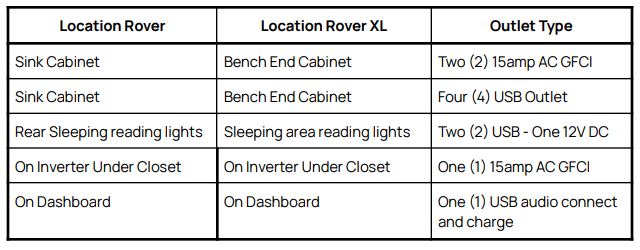
POWER OUTLETS
Your campervan comes equipped with seven (6) USB plugs and five (3) 15amp AC GFCI
outlets. Their locations are as follows:
KNOWING YOUR BATTERY’S STATE OF CHARGE (SOC)
Your battery's state of charge or SOC is shown on the battery monitor screen. This screen is
mounted in the bench end cabinet (Rover XL models) or in the passenger wall near the sink
(Rover models).
This screen shows you the battery's current charge level, its charge input in amps/volts and
its draw to your connected utilities. Your van is equipped with either a 200 or 400 amp hour
lithium battery bank. Your state of charge is shown in both amp hours and by percentage.
MAXIMIZING YOUR BATTERY CAPACITY
While it’s true that the your campervan has a fully off-grid electrical system designed to be
self-sustaining on solar and alternator power, we always recommend taking the following
steps to maximize your experience and battery capacity:
Park in direct sun when possible: Parking in the shade will prevent the solar panel from
collecting enough energy to keep your batteries topped off. If parking in the shade is
unavoidable, try to conserve power consumption as much as possible.
Drive the van: the engine's alternator charges your batteries at nearly quadruple the rate
that solar does while driving. If at all possible, schedule your power consumption around your
driving plans.
Charge your devices when the sun is out: Most of the devices we use in our day-to-day
lives have batteries of their own. Take the opportunity, when the sun is out, to charge these
devices. This way, you can use your personal devices at night without robbing from your
house battery bank.
If you’re not using it, turn it off: Leaving unused utilities turned off extends the utilities
life-span and conserves your battery capacity. The inverter and water pumps use power even
when not in use, that’s why we’ve installed ‘off switches’ for them. It’s important to note that
things like the fridge, roof fan, and overhead lights are low power - we designed the system to
run these all the time. If you would like to turn off ALL utilities to ensure absolutely NO power
is being drawn from your battery bank:
1. Disconnect power to your fuse block with the master kill switch located in the utility
bay.
2. Turn the power switch on the Inverter to “OFF” rather than “REMOTE”.
3. [Optional AC package] Turn off the air conditioner on the unit itself.
LIGHTING
Main ceiling lights are turned on and off using the dimmer switch located on the passenger
wall to the right of the slider door entrance (Rover only) or on the bench end-cabinet to the
right of the sliding-door entrance. Garage lights are turned on and off using the switch on
the rear face of the utility box next to the shower pump switch and fill port. Kitchen area
lights are turned on by a small round switch located on the bottom left of the overhead
cabinet above the refrigerator.
RESOLVING CHARGE SYSTEM ISSUES
If you are experiencing unusually low battery levels, or your utilities stop working all together
- work through these fixes in order.
STEP 1 [IF NO UTILITIES WORK]: Turn the solar controller Off and On again using the “Right
Arrow” key on the face of the controller located in the utility closet underneath the bed. This
can also be achieved via APP control when your solar controller is connected via Bluetooth to
the “Renogy solar BT” app on your smartphone.
STEP 2: Reset all power breakers under the sink (Rover XL only) or behind the Kitchen drawer
set (Rover only).
STEP 3: Verify that your battery-to-battery charge relay is functioning. Note the house
battery level with the engine off, after turning the engine on, the house battery level voltage
should rise to match the engines alternator output within 60 seconds.
STEP 4: Check that inline fuses and breakers for the engine charge system are not blown or
tripped. These can be found at both the starter battery and inside the kitchen base cabinet
on the drivers side (refer to “Fuse, Breaker and Power switch locations” below.)
STEP 5: Lastly, inside the utility bay is the master utility shutoff switch - turn this switch off
and wait 60 seconds before turning back on again (note: this will reset all stored settings for
your campers 12V electrical appliances)
NOTE FOR OPTIONAL OFF-GRID A/C UNITS: Your air conditioner is connected to the house
battery bank on a dedicated circuit, not monitored by the solar controller. When viewing
battery voltage on the solar controller, the reading may be flawed, if the air conditioner is
running.
FUSE, BREAKER, AND POWER SWITCH LOCATIONS
FUSE BOXES
Mercedes install fuses in three major locations in the chassis. Refer to your Mercedes
owners manual for detailed information about chassis fuse locations and accessibility.
VanCraft utilizes fuses for all 12v utilities that are controlled by the Solar Controller. These
fuses are in a fuse box inside the utility bay in the garage area of the van.
12V FUSE BLOCK DIAGRAM
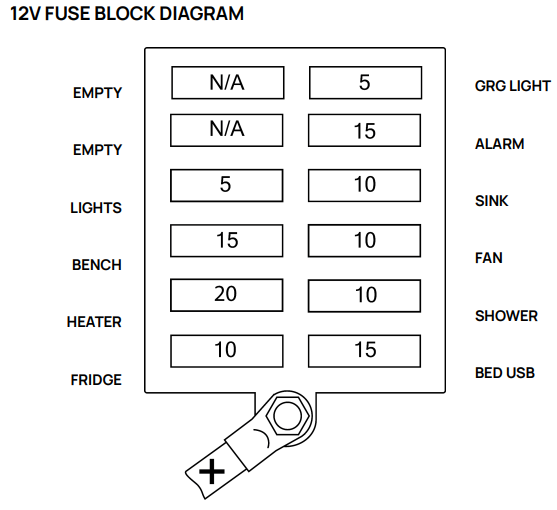
NOTE: Always replace fuses with fuses of the same size and amperage rating.
Fuses can also be found here:
● The starter battery connection below the driver footwell for the battery-to-battery
charge system.
● In the house battery box for the optional air conditioner.
● In the driver's seat base main fuse bay for the optional audio system, bumper
mounted light pods, and the diesel heater.
BREAKERS
Breaker switches protect power leaving the battery compart to larger draw utilities in the
van. In the kitchen base cabinet next to the refrigerator controller are three-four (3-4)
breakers for:
1. Power inverter
2. Solar controller
3. Battery-to-battery charge relay
4. Solar controller (optional)
These breakers trip if they are overloaded. If they are tripped in the open position, they
should be closed to be reset. If the breaker continues to trip open, their corresponding
device is pulling too many amps due to misuse or internal failure.
110V AC SYSTEM
The 110V system is powered via the inverter, 12V DC current is inverted to output 115V AC
similar to the power found in your home. The inverter sends power to the 15 amp 110V GFCI
protected wall outlets and cooktop. To run the 110V system, the inverter power switch must
be turned to “Remote”, then turn on your remote inverter switch located on the passenger
side of the van.
110V SYSTEM PROTECTIONS
The power fed to your inverter from the House Battery Bank is first protected by a breaker
switch. This breaker is located behind the lower drawers in the galley base cabinet (Rover
only) or under the sink (Rover XL only).
Power is inverted and then sent out to utility via GFCI Protected outlets. Both the induction
cooktop and wall outlet in your van utilize 15 amp GFCI protected outlets on the side of the
inverter. An extra 15 amp socket remains for garage area power as needed.
Please refer to the Inverter’s manufacturer specific manual for more information and safety
warnings.
WARNING
The GFCI will not completely eliminate the risk of electrical shock. Infants and small
children may still be affected.
CABIN CLIMATE CONTROL
OPTIONAL AIR CONDITIONING
Before using the air conditioner, first familiarize yourself with its included instruction manual.
Your air conditioner is designed for off-grid style 12V DC power systems. It accomplishes this
with its included “ECCO” run mode. “ECCO” mode cools your cabin at a max of an 18 amp
draw. All other run modes are designed for units with “Shore Power” connections or onboard
generators. It is possible to run the air conditioner on other modes for short periods of time
but be advised that it will use large amounts of available power quickly. Like the Power
Inverter, the air conditioner is individually connected to the battery bank and therefore has
no reference to the battery's output to other utilities in use. While using the air conditioner,
try to conserve power usage from other utilities as much as possible to conserve battery
draw.
Other power saving tips include deploying the awning whenever possible, and only using the
air conditioner when the window covers are installed.
USING THE EXHAUST FAN
Vans without a roof air conditioner have an exhaust fan and roof vent. Use this fan to prevent
harmful gasses from building up inside the living quarters of the van, remove cooking odor
from the van, and draw cool or hot air from the vans dashboard HVAC system to the rear of
the van.
Only open the roof vent a quarter of the way while the van is in motion. Use the lock when
closed.
DIESEL CABIN HEATER
Before using the cabin diesel heater, first read the included instruction manual. The heating
system uses diesel from the Sprinter’s primary fuel tank to fire a small furnace for heating
cabin air. The heater can be run with the van’s engine off and the inverter does not need to be
on. Follow instructions in the heater manual to turn the unit on and off and adjust cabin
temperature.
NOTE: The diesel-fired furnace will not operate if the vehicle’s fuel tank level is under 1/8 tank.
NOTE: It is normal for the interior lights to flicker slightly while the furnace starts.
NOTE: Do NOT turn off the 12V power system system if the furnace is on. This includes
breakers, fuses, master power disconnect switch, and the solar controller itself. Turn the
furnace switch to OFF on the heater controller only, then wait at least 10 minutes for the
furnace to shut down properly.
TROUBLESHOOTING THE DIESEL HEATER
Troubleshooting steps can be found in the heaters instruction manual. If you are having a
tough time starting the heater check that:
● The diesel tank is above 1/8 full
● The battery system is sufficiently charged (12.5V minimum)
● You're operating the heater below 10,000 feet of elevation.
PLUMBING SYSTEMS
Your campervan is outfitted with a self-contained water system. Your campervan does not
support the use of a city water connection and is tank fed only.
WARNINGStanding water left unattended in the van can cause damage to cabinets, floor, electronics
and other components found in your campervan. Always take immediate action to clean up
water spills and fix leaks in plumbing systems. If a leak cannot be fixed, drain all holding
tanks until your van can be brought to a qualified service station for repair.
Lastly, failure to winterize plumbing systems before the onset of below freezing
temperatures can result in water leaks and subsequent water damage.
OUTDOOR SHOWER
The utility box, on the passenger side of your garage area (under the bed), houses a 40
gallon water tank. This tank supplies water to all plumbing fixtures in your van via a water
pump/accumulator combo, located behind the water control panel in the front of the utility
box.
NOTE: Never leave the water pump on when not in use or when unattended.
FILLING THE WATER TANK
The water-fill port is located on the bottom left of the water control panel on the front face of
the utility box (under the bed).
● Unscrew the cap on the fill-port.
● Using a standard garden hose (it is helpful to have a spray nozzle attached), press the
hose into the fill port opening and then begin the flow of water to fill the tank.
● As the tank fills, the tank fill gauge will read its level. If it is difficult to read the gauge,
turn on the garage lights to illuminate the gauge.
● When the tank gauge reads full, turn off water flow from the gauge and screw the fill
port cap back on.
NOTE: It is important to clean up any spilled water immediately to avoid damage to the
campervan’s cabinets, flooring, and other systems..
CLEANING THE TANK
● Fill the shower water tank half way and mix in ⅜ cup of household bleach into the tank
before completely filling the tank with a total of 18 gallons of fresh water.
● Let the full tank sit for 4 to 8 hours.
● Run the water tank dry by turning on the shower pump and running 18 gallons of water
through the shower head.
● Refill the water tank with fresh water and drain several times to flush the system.
DRAINING THE TANK
The water tank can be drained by running the outdoor shower until the tank is empty.
USING THE OUTDOOR SHOWER
Your outdoor shower can be used for many different purposes. Because it is the only hot
water source in your van, it not only is a great way to take a shower but also serves an
excellent utility for outdoor dish cleanup.
WARNING
This accessory hot water shower is designed for use in areas with direct airflow to the
outdoors. NEVER use the hot water heater with the rear cargo door closed. NEVER leave the
low pressure propane canister connected while the water heater is not in use or
unattended. ALWAYS turn the hot water heater igniter switch to the “OFF” position when
not in use. And only ever open the water supply valve to the water heater when in use,
NEVER LEAVE THE WATER SUPPLY BALL VALVE ON WHEN THE SHOWER IS NOT IN USE.
Please follow the steps below to operate your shower:
1. Make sure the shower hose, shower head, and shower water flow are connected
together firmly and that the entire hose assembly is connected firmly to the shower
heater.
2. Connect propane to the low pressure regulator.
3. Turn on the water heater flame igniter (located on the bottom of the water heater).
4. Turn water flow to the water heater “ON” using the ball vale on the bottom of the
heater.
5. Turn on the water pump switch, water will then flow through the heater and out of the
shower head. You can hear the igniter clicking before igniting flame visible through
the three water droplet icons on the front face of the water heater.
6. Adjust water temperature using the control knobs on the face of the heater.
7. You can limit water flow or stop the flow of water completely using the flow
adjustment on the shower head.
8. When done, turn the water pump switch OFF.
9. Open the shower head flow restrictor valve and release any residual water from the
line by placing the shower head below the tank and shaking firmly.
10. Immediately wipe up and water that may have dripped inside the van.
NOTE: Always be sure to winterize your shower if you are camping or leaving your vehicle in
freezing weather conditions.
WINTERIZING YOUR WATER SYSTEM
If your van is in freezing temperatures, or will be when you get to where you are driving, it is
imperative that you winterize the vans water system to prevent damage to your plumbing
system, electrical systems, and cabinet features.
Winterize your campervan’s shower with the following steps:
1. Turn the Winterise valve on your water control panel to “WINTERIZE”.
2. Be certain that the water supply ball valve to the shower heater is “OFF”.
3. Turn the sink faucet on.
4. Turn on the water pump and wait for the flow of water to stop then turn off the faucet.
5. Turn on the shower water supply ball valve and run the shower until water stops
flowing from the shower head.
6. Turn off the shower head and turn off the water supply ball valve.
7. Turn the water pump off.
8. Connect compressed air to the blow out port on the bottom plate of the utility bay.
You can use a home compressor, portable compressor, or gas station tire fill center. Be
sure the compressor is set to supply a minimum 30 PSI and no more than 50 PSI of air
pressure.
9. Repeat steps 4-6 with the water pump OFF, giving ample time for the compressed air
to blow out as much moisture as possible from both the faucet and the shower
plumbing.
In mild temperatures, while camping in the van with the heater on, you can use the sink by
turning the winterize valve back to “ON”. Do not turn the shower water supply ball valve on or
the shower will fill with water. The shower is EXTREMELY susceptible to freeze damage.
In extreme cold, or when storing the van through winter season, extra precaution should be
taken by:
● Drawing the water tank.
● Filling the plumbing system with RV antifreeze via the blow out port.
KITCHEN SINK
The sink is pressurized by the water pump in the rear of the van.
NOTE: Never leave the water pump on when not in use or when unattended. Always confirm
the shower water supply valve is OFF before turning on the water pump.
KITCHEN SINK DRAIN
The sink drains directly to the ground beneath the van. For this reason it is important to
monitor what is flushed down the drain. Do not pour chemicals, food scraps, or other items
harmful to the environment down your sink drain. If it is necessary to run chemicals through
the drain to winterize the system or clean out a clogged drain, be sure a receptacle is placed
below the drain outlet under the van to catch the draining liquid.
NOTE: Always use the included sink strainer to protect the drain from items that may cause
clogs.
REFILLING THE SINK SOAP DISPENSER
The sink comes equipped with a soap reservoir and pump. You must fill the soap pump from
the top of the sink by pulling up on the pump head. Remove the pump head and pickup tube.
WARNING
Never remove and fill the soap pump reservoir bottle from the bottom of the cabinet.
Removal and reinstallation of the reservoir may damage the threads of the reservoir.
REFRIGERATOR
The refrigerator is located under the countertop on the left side of the kitchen base cabinets
located on the driver side of the vehicle. It is designed to run all the time and can only be
turned off by disconnecting its power cord or disconnecting all utility from the solar
controller via the app or main switch (under the bed in the utility box). Refer to the
manufacturer's instruction manual for specific operation and warranty information.
NOTE: Always run the refrigerator on “Low-Speed” mode.
NOTE: NEVER remove the drain plug without first removing the fridge from the campervan.
Always remove the refrigerator before draining.
ADJUSTING REFRIGERATOR SETTINGS
The refrigerator control panel is accessible by opening or removing the middle drawer in the
kitchen base cab (Rover only) or under the sink on the left side wall of the cabinet (Rover XL
only). Set the refrigerator to “Low Speed” mode every time the refrigerator is turned off by
power reset or after removal. Press “Mode” repeatedly until the “Low Speed” green light is
illuminated to the right of the control screen.
REMOVING THE REFRIGERATOR
In order to clean the refrigerator, repair or send it in for warranty, or to access the Solar
Battery Bank, the refrigerator will need to be removed.
1. Remove the hinge screws holding the refrigerator lid to the countertop.
2. Unplug the refrigerator (plug is located next to the control screen).
3. Remove fridge baskets and all food items.
4. Pull the refrigerator upward to remove.
INDUCTION STOVETOP
Some vans are equipped with an optional 1600W single burner induction cooktop. The
cooktop runs on 110V AC electricity, so the power inverter must be on to use the cooktop.
Please monitor your batteries power consumption closely when using the cooktop, it
consumes power quickly.
NOTE: Induction compatible cookware is required. (minimum 4” diameter, magnetic)
NOTE: Refer to the manufacturer’s user guide provided for complete instructions.
SLEEPING AND SEATING SYSTEMS
SWIVEL SEAT
The front passenger seat has a seat-base swivel system, allowing it to rotate towards
the rear of the van. Before rotating the seat, adjust it all the way forward to prevent it
from rubbing or scratching the vehicle’s door trim.
While standing next to the seat or outside the open passenger door, use the red
lever, located below the front-center seat cushion, to rotate the seat
counterclockwise. Use the lever again to unlock and rotate the seat further or back to
the forward position.
NOTE: Never travel in the campervan with the seat facing backward. Never rotate the
seat 360° to prevent the seat belt from twisting.
REAR BENCH
The rear bench-seat has room to seat two (2) passengers (Rover) and four (4) passengers
(Rover XL). There are type-1 lap-belt style seat belts installed for each passenger. When the
van is in motion all passengers MUST wear seat belts.
The cushioned horizontal bench-back folds up to extend the sleeping area of the bed. Be
conscious and attentive to make sure bedding is not pinched in the latch when engaging the
bench-back to prevent damage to both the bench-back hardware and your bedding. Make
sure both latches are engaged, by pushing down on the bench-back, before climbing up into
bed.
Do not try to collapse the bench back from on top of the bed. First climb out the bed and
stand on the ground while lowering the bench back. Release the latches by pushing upward
on the latch triggers.
MAIN SLEEPING AREA
The elevated bed above the garage is designed to utilize the extension provided by the
bench back when in the upright position. The recommended sleeping position is to place
your head towards the rear of the vehicle and your heels resting on the bench-back
extension.
BENCH SLEEPING
There is enough room for a child under 4’ tall to sleep horizontally on the Rover bench seat.
The Rover XL L-bench offers an additional sleeping surface for an adult up to 6’ tall. There is
also an optional Bed-to-Bench conversion kit for the Rover XL model.
Sleeping with your head under the bench-back when it is in the upright position is prohibited.
It is important that if any passengers are sleeping on the bench that the bench back is first
locked into place and tested for security to prevent the bench-back from falling on a
passenger sleeping below.
OPTIONAL: UPGRADED SOUND SYSTEM
FOR VANS WITH OEM TOUCH SCREEN MULTIMEDIA CENTER
For specific information on controlling your Mercedes Benz Multimedia system please read
the Mercedes Benz Sprinter owners manual.
All audio tuning adjustments for your system can be adjusted using the controls offered on
the LCQ-1 unit located behind the bottom drawer in the kitchen base cabinet. This unit is
installed to adapt new audio hardware to your existing Mercedes Multimedia System. Added
systems that are controlled by the LCQ-1 include:
● Front Speakers (L/R)
● Rear Speakers (L/R)
● Amplifier
● Subwoofer
Audio settings for these systems have been tuned and adjusted during the quality control
process at our factory. To make changes to the speaker levels and system settings, please
refer to the LCQ-1 Manual. Be careful making these adjustments, these systems have a
multitude of settings and a thorough understanding of their function is necessary to prevent
damage to your system.
The volume of your added 10” Pioneer subwoofer can be adjusted via the bass control knob if
equipped (low to the left of the steering column), or on your Mercedes Multimedia System.
35
FOR VANS WITH AN UPGRADED PIONEER TOUCH SCREEN STEREO
For specific instructions on operation of the Pioneer Stereo system, including output
settings, navigation, and connectivity - please refer to the provided Pioneer Operators
Manual.
For Apple Carplay and the best phone connectivity experience, plug your phone directly into
the provided phone connectivity port on the top center of the dashboard.
Your system is made up of several components that interact together to bring you a balanced
stereo experience:
● Stereo/touch screen media center
● Two Front Speakers
● Two Front Tweeters
● Two Rear Speakers
● One 1600W Amplifier
● One 10” 1200W Subwoofer
NOTE: Control speaker output, balance, and fade directly in the options menu of your Stereo
Screen.
EXTERIOR ACCESSORIES
FRONT BUMPER LIGHT PODS
Your campervan’s two-stage LED light pod system is integrated into the front bumper and is
turned on via two red switches (to the right of the steering column). If the switches are
illuminated red, the lights are turned on.
The white lights are intended for low light conditions, while the yellow lights are designed to
cut through fog and snow. Like all electrical systems in your van, prolonged use could result
in a dead battery.
AWNING
To best learn to operate your awning, refer to the included Thule manual. A how to
video can be viewed here:
The awning crank rod is stored under the bed on the driver-side wall. The awning
pitch adjustment screws have been adjusted to avoid the awning form hitting the top
of the slider door when in the open position.
LADDER
Your rear door ladder has a weight rating of 275lbs. Be careful when climbing up and
down the ladder.
WARNING
DO NOT CLIMB ON THE LADDER WITH THE DOOR OPEN. Standing on the ladder with
the door open will damage the door and hardware.
CAMPERVAN REGULAR MAINTENANCE
BUTCHER BLOCK COUNTERTOPS
VanCraft campervans come standard with solid oak butcher block countertops. These
beautiful countertops are chosen for their elegance, durable makeup, and ease of
maintenance. They are treated before installation with a 3-day soak in our favorite butcher
block oil to seal them from water and stain intrusion.
Over time, your countertops will encounter stains and normal wear-and-tear. Spot treating
and refinishing the butcher block is a regular part of campervan ownership. Additionally, your
countertops will need regular re-applications of a good butcher block oil to keep them sealed
and protected.
We recommend applying a nice sealant layer of oil every 4-6 weeks, when used regularly. You
can find butcher block oil at your local hardware store or at many online retailers. Simply
apply with a cloth and let soak for 2-3 hours before wiping away with a clean cloth. For more
intensive spot treatment and refinishing, sand the oil into the grain of the wood using
120-200 grit sandpaper.
ROOF SEALANT
Your vans roof accessories are sealed with a coating of “RV Lap Sealant” as an extra layer of
protection from water intrusion, where fasteners penetrate the roof structure. Like all RV’s
this lap sealant should be inspected and re-coated every 3 years. This can take place at any
RV service center or can be done easily yourself.
LATCH ADJUSTMENT
Your van's cabinet drawer and door latches may fall out of adjustment with time. Loading
drawers with heavy cargo, off road driving, or a shift in climate can add to the misalignment of
your latches. It is important to keep your latches adjusted properly so that your drawers,
doors, and cargo stay put.
All latches have slotted screw holes so they can be aligned when necessary. Use a phillips
screwdriver to gently loosen the latch and re-aline before tightening.
STORING YOUR VAN
If you’re planning to store your van for an extended period of time, follow these steps
to ensure your van is prepared for storage.
● Follow Mercedes Instructions for storing your van (see extended parking).
● Winterise your plumbing: there must be no water in your van.
● Disconnect utility from your solar controller (use the battery switch in the
utility box)
● Turn off the charge relay breaker switch
● Turn off the solar breaker switch
● Turn off the Inverter-charger breaker switch
EXTERNAL LINKS
Resetting Your Vans Electrical System
Solar Charge Controller
Air Conditioner
Refrigerator
Awning
Diesel Heater Controller/Display